
The Future of Mobile eDiscovery What Legal Teams Must Prepare For
Mobile evidence is reshaping modern disputes, investigations, and regulatory responses because work now happens inside phones and chat threads. Legal teams that want speed, defensibility, and proportionality must modernize workflows, especially around eDiscovery services, preservation, and review at scale.
Messaging Apps and a Mobile-First Work Reality in eDiscovery Services
Work communication has shifted from email toward mobile chat, rich media, and app-based collaboration, which creates a wider evidence footprint on personal and corporate devices. A single matter may involve SMS, iMessage, or WhatsApp attachments often mixed with personal content in BYOD scenarios. Mobile data collection now sits alongside traditional ESI as a core part of discovery planning.
That shift changes what “reasonable” preservation looks like. Screenshots and manual forwarding usually fail to capture the full conversation context. They also create avoidable disputes about completeness and authenticity. Mobile-first work, therefore, pushes legal teams toward repeatable methods that can preserve integrity and support defensible production.
Mobile messaging also increases sensitivity around privacy. Phones often contain unrelated personal conversations, photos, and location signals. When the collection scope is broad, review volume rises, and privileged exposure risk climbs. A future-ready approach treats targeting as a first-class requirement, not a courtesy.
Regulatory Scrutiny Is Rising for Off-Channel Communication
Regulators increasingly focus on off-channel business communications that occur outside firm-controlled systems, including texts and chat messages. For broker-dealers, recordkeeping obligations include requirements to create and preserve business communications such as emails, instant messages, text messages, and chat messages, supported by written supervisory procedures.
The practical takeaway is broader than financial services. Any regulated organization should expect faster deadlines, tighter proof requirements, and more pressure to demonstrate a consistent process. That means documented governance, clear authorization, and audit-ready tracking, starting at the moment of collection.
Automation and Scalability Will Define Winning eDiscovery Services Workflows
As mobile evidence volume grows, manual processes become a bottleneck. Teams will need automation that reduces time-to-review, limits irrelevant capture, and produces consistent outputs. This is where modern mobile data collection software differs from legacy mobile forensics services that were built for technician-led lab work.
Three trends matter most:
Remote, custodian-guided acquisition will become standard for many matters, especially when parties are distributed and timelines are short.
Targeted scoping will expand, with filters like date range, app selection, and custodian-specific criteria used early to control downstream workload.
Review readiness will be treated as part of collection, not a separate cleanup project. This is so counsel can analyze sooner and iterate faster.
A scalable model also needs defensibility features that survive challenges. Legal teams will rely more on chain-of-custody documentation, comprehensive audit logs, and integrity controls that show what was captured and when. Those expectations mirror the way traditional ediscovery software matured over the last decade, but with added privacy constraints unique to phones.
This is also where integration becomes strategic. Mobile evidence rarely lives alone. It must connect to broader case strategy, productions, and sometimes third-party review stacks. Teams should look for mobile data collection tools that export in common legal formats and support predictable operations across multiple matters.
Where PME Fits in Modern eDiscovery Services
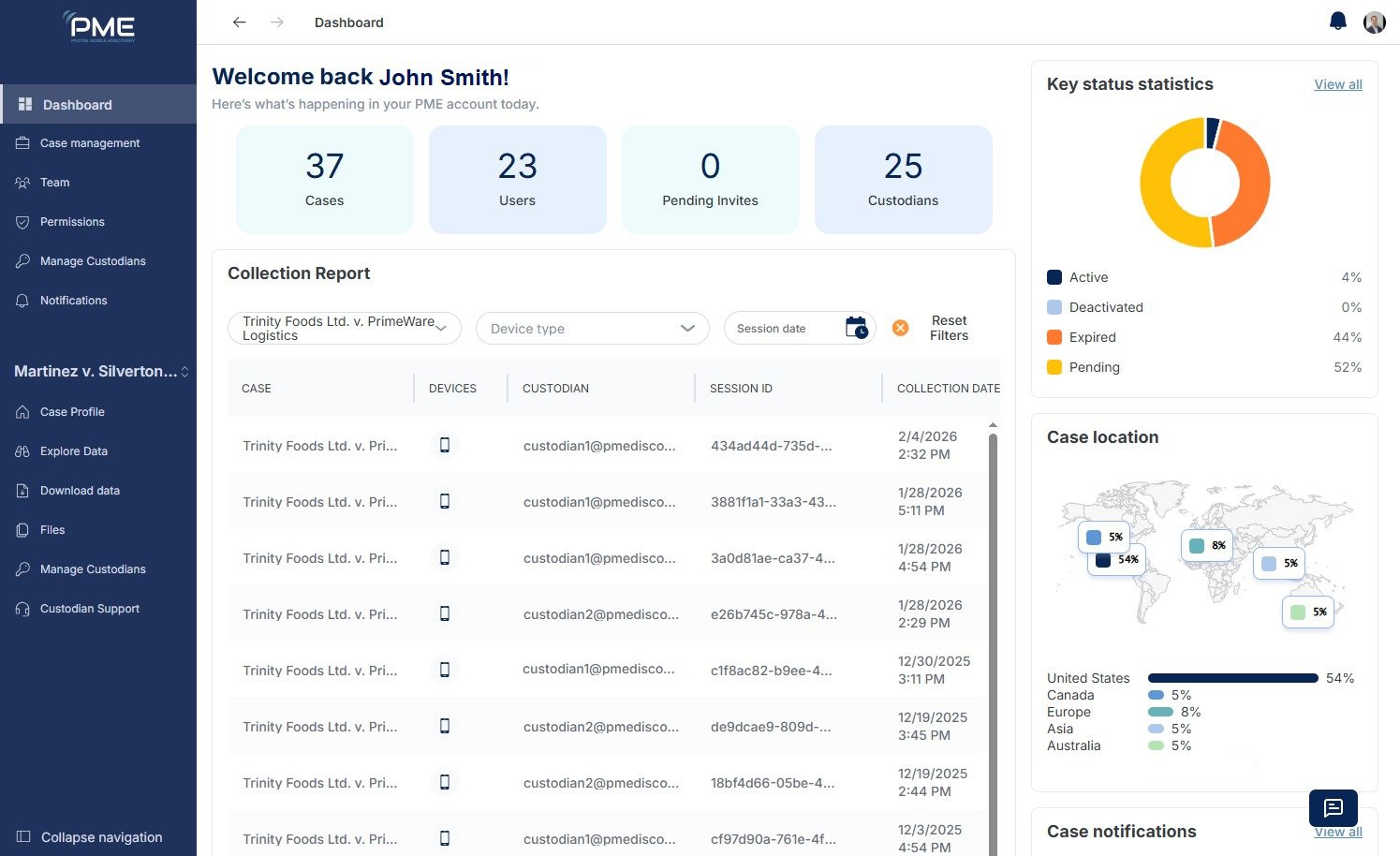
PME is a technology platform focused on mobile device data collection and web-based review for eDiscovery and other matters needing defensible extraction and analysis of mobile data. The platform centers on two components. PME Collect, a targeted remote collection capability, and PME Review, a browser-based review and case management environment.
PME Collect is designed to remotely pull relevant mobile data types without shipping kits or requiring on-site technicians, and it supports scoping such as filtering by app, date, and contacts. Review supports search, tagging, redaction, commenting, and export, enabling teams to work with collected mobile evidence through a web interface. PME supports iOS and Android and includes security, encryption, and compliance controls across the workflow.
This combination maps closely to what legal teams are preparing for. This includes remote-first operations, proportional acquisition, fast review readiness, and evidence governance that can be explained to courts or regulators.
Build a Mobile-Ready Discovery Program With PME
Run a mobile communications readiness check before the next urgent matter lands. Define which custodians, apps, and time windows are most likely to be relevant, then document a defensible playbook for remote collection, privilege protection, and production formatting.
PME can support that preparation with targeted remote collection workflows and a review environment designed for mobile evidence. This can help teams move from capture to analysis with clearer governance. If your team is evaluating options for mobile data collection software, schedule a PME demo and request a pilot plan that matches your matter types, device mix, and regulatory profile.
FAQ
1) What types of mobile data can PME collect for legal matters?
PME supports the collection of popular chat apps such as SMS, iMessage, WhatsApp, Line, Viber, WeChat, and more, along with attachments, media, call logs, contacts, browser history, and additional app-related data. PME has support for both iOS and Android devices.
2) How does PME help with defensibility and chain of custody?
PME is designed around repeatable workflows with audit logs, reporting, and chain-of-custody support to help reduce admissibility challenges and support legal scrutiny.
3) Can PME support cross-border matters and data residency needs?
PME offers regional data storage options and privacy-focused, targeted collection approaches intended to support compliance needs in multi-jurisdiction matters.